
Homepage

LongViewValue   /   Value Investing Research

Understanding Businesses.
Valuing Their Future.

Research on price, business quality, and long-term intrinsic value — grounded in value investing.

Margin of safety   ·   Business quality   ·   Patient capital

01   /   The Research Framework

Price. Business quality. Long-term value.

Every investment begins with a relationship between the price paid and the value received. Our research examines that relationship through three questions.

01

What are we paying?

Compare the market price with a conservative estimate of value, allowing for uncertainty.

02

What are we owning?

Examine the business model, competitive advantages, cash generation, and capital allocation.

03

How might value change?

Assess how the business could develop over time, what owners may receive, and what could go wrong.

Foundational Essay   ·   04 Oct 2026

From Graham to Buffett:
How Value Investing Evolved

From cheap assets to durable businesses — how Graham's discipline and Buffett and Munger's focus on quality inform a framework suited to different market conditions.

Read the Framework →
02   /   Framework in Practice Tencent Holdings · 0700.HK
View Research Hub →
Complete Series · All five chapters published

Tencent: a complete investment case.

Five chapters connect WeChat's economic moat, AI strategy, capital allocation, and valuation — showing how the research framework applies to a single business.

“The moat is not the product. The moat is every relationship inside the product.”
FCF FY2025
182.6B RMB
P/B RESEARCH REFERENCE
3.24× vs 6.5× median
ROE FY2025
21.1% return on equity
Financial data: FY2025 · Homepage updated 04 Oct 2026
P/B figures are historical research references, not live market quotes.
Start Here Part 1 · Investment Thesis
The WeChat Moat, Capital Discipline, and the AI Option Nobody Has Fully Priced
A value investing analysis of Tencent Holdings (0700.HK), exploring its WeChat moat, capital allocation discipline, AI optionality, valuation, and long-term intrinsic value.
By Value Architect — 08 Jun 2026
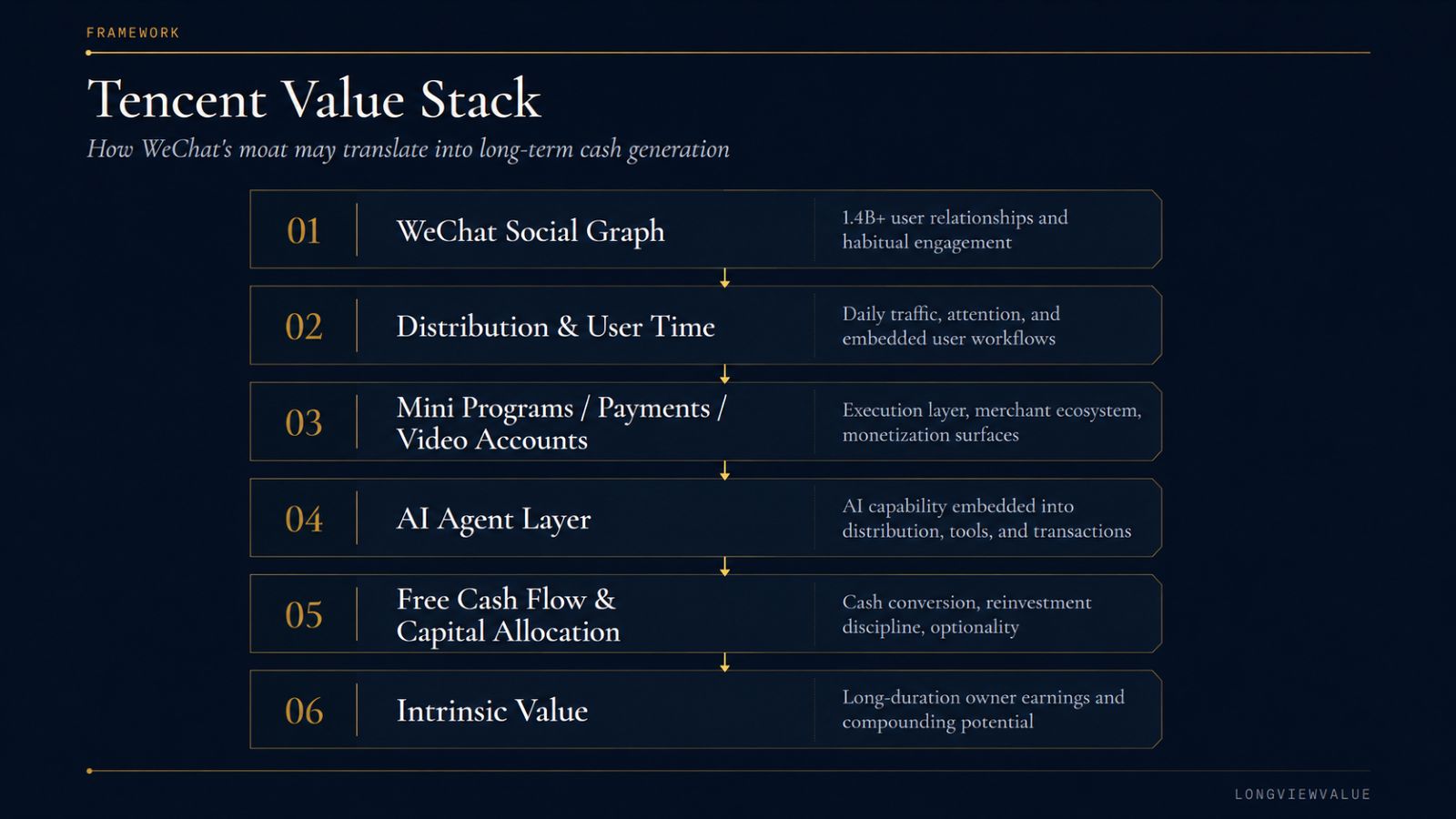
Tencent Value Stack framework illustrating how WeChat's social graph, distribution, AI, capital allocation, and free cash flow may contribute to long-term intrinsic value.
Figure 1. Tencent Value Stack — from social graph to owner earnings.
Part 2 Economic Moat
The WeChat Moat
How relationships become infrastructure — and why Tencent's social graph creates switching costs that competitors cannot replicate.
By Value Architect — 14 Jun 2026
Part 3 AI Strategy
AI Strategy, Value Capture, and the Agent Era
A first-principles analysis of Tencent's AI strategy, exploring how WeChat's distribution, mini-program execution layer, and payment infrastructure may convert AI capability into long-term free cash flow.
By Value Architect — 27 Jun 2026
Part 4 Capital Allocation
Capital Allocation and Owner Earnings
How Tencent converts accounting profits into owner earnings and free cash flow — and allocates that cash across AI investment, share repurchases, dividends, strategic assets, and long-term per-share value creation.
By Value Architect — 11 Jul 2026
Part 5 Valuation · Series Conclusion
Valuation and Margin of Safety
Bringing the Tencent research framework together through P/B, SOTP, DCF, and owner earnings — with explicit assumptions, scenario-based estimates, and conditions for a margin of safety.
By Value Architect — 04 Oct 2026

Research Notes

Follow the research as it develops.

Receive new company research and investment frameworks when they are published. Long-form analysis, delivered at a considered pace.

Subscribe to Research Notes →